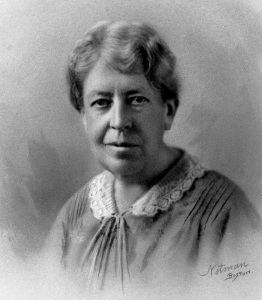
 Mary Whiton Calkins (March 30, 1863 - February 26, 1930) was a pioneering American philosopher and psychologist whose groundbreaking work shaped the
scientific study of memory, dreams, and the self.
Mary Whiton Calkins (March 30, 1863 - February 26, 1930) was a pioneering American philosopher and psychologist whose groundbreaking work shaped the
scientific study of memory, dreams, and the self.Queer Places:
Smith College (Seven Sisters), 9 Elm St, Northampton, MA 01063
Wellesley College (Seven Sisters), 106 Central St, Wellesley, MA 02481
Harvard University (Ivy League), 2 Kirkland St, Cambridge, MA 02138
Mount Auburn Cemetery, Cambridge, Middlesex County, Massachusetts, USA
Mary Whiton Calkins (March 30, 1863 - February 26, 1930) was a pioneering American philosopher and psychologist whose groundbreaking work shaped the
scientific study of memory, dreams, and the self.
Born on March 30, 1863, in Hartford, Connecticut, she was the eldest of five children born to Reverend Wolcott Calkins and Charlotte Grosvenor Whiton Calkins. In 1880, her family moved to Newton, Massachusetts, where her father took up a new post as a Presbyterian minister. Her early education included a year at Smith College, followed by a period of travel and private tutoring in Greece after the tragic death of her sister, Maud. She returned to Smith College to graduate in 1884 with a degree in classics and philosophy, a background that heavily influenced her later psychological inquiries.
Following an eighteen-month tour of Europe with her family, Calkins began her long-standing professional association with Wellesley College in 1887, initially hired as a tutor in the classics department. Her exceptional teaching ability soon caught the attention of the philosophy department, which offered her a position teaching psychology on the condition that she spend a year studying the subject first. This endeavor led her to Harvard University, where—despite heavy institutional resistance from university president Charles William Eliot—she was permitted to sit in on lectures as a guest under the mentorship of luminaries like William James, Josiah Royce, and Hugo Münsterberg.
During her advanced studies, Calkins established the first psychological laboratory run by a woman in the attic spaces of Wellesley's College Hall in 1891 and conducted systematic research on dreams alongside Edmund Sanford. Between 1894 and 1896, she completed rigorous doctoral research under Münsterberg, inventing the paired-associate learning technique—a foundational tool for memory and recall research that is still utilized today. She successfully fulfilled all requirements for a Ph.D. at Harvard, with William James declaring her performance the most brilliant examination the university had ever witnessed. However, solely due to her gender, Harvard refused to confer the official degree. She later famously rejected an equivalent doctoral degree offered by Radcliffe College, maintaining her principled stance against unequal academic recognition.
Calkins spent four decades on the faculty at Wellesley College, rising to professor of psychology and philosophy and heavily contributing to her self-developed system of self-psychology. Her scholarly eminence earned her immense national recognition, culminating in her historic elections as the first female president of both the American Psychological Association in 1905 and the American Philosophical Association in 1918. In addition to her academic pursuits, she was a dedicated suffragist, pacifist, and member of the American Civil Liberties Union.
Beyond her professional and political milestones, Calkins's personal life was anchored by deep and enduring relationships, most notably her profound connection with the poet and Wellesley professor Sophie Jewett. The two women shared an intimate bond that flourished alongside their academic careers until Jewett's passing in 1909, after which Calkins lovingly compiled and published a collection of Jewett's verse as a literary tribute. Mary Whiton Calkins passed away on February 26, 1930, in Wellesley, Massachusetts, and is buried at Mount Auburn Cemetery in Cambridge, leaving behind an indelible legacy as a titan of early psychology and women's higher education.
References:
 In Adamless Eden: The Community of Women Faculty at Wellesley by Patricia Ann Palmieri |
Other references:
Support this project
This website is a passion project researched, developed, and funded entirely by me. If you find the content valuable and would like to help support the ongoing research and hosting costs, any contribution is deeply appreciated.
Thank you for keeping this independent resource alive!
My books on Amazon: Elisa Rolle's books